
- How To Install the Astra Theme
- System Requirement for Astra Theme
- What Is a Child Theme and How To Install It for Astra?
- Manually Install Astra via FTP
- How to Update Astra Theme Manually?
- Automatic Beta Updates for Astra
- Astra 4.2.0-beta.1 : Migrations & Backwards Compatibility
- Know More about Astra Beta Versions? How to Download and Use?
- How to Set Up a WordPress Multisite Network and Use an Astra Child Theme
- Getting Started with Astra Pro Addon Plugin
- What is Astra Pro Add on?
- How to Install Astra Pro Plugin?
- How to Get License Key of Astra Pro?
- How to Activate Astra Pro Addon License?
- How to Fix “The Package Could Not Be Installed. The Theme Is Missing the style.css Stylesheet” Error
- Why Can’t I Access Astra Pro Features After Purchasing the Pro Version?
- Do Not See License Activation Form for Astra Pro Addon Plugin?
- How to Fix “Sorry, You Are Not Allowed To Access This Page” Error In Astra Pro
- How to Download Your Purchase Invoice
- How to Manage License on Store?
- How Do License Upgrades Work?
- How To Update Your Payment Method?
- How to Process Refund Requests?
- How to Apply For Brainstorm Force Affiliate Program? (Become Astra Affiliate)
- Frequently Asked Questions – VIP Priority Support
- How do I check my Support Ticket History?
- How To Create a Header With Astra Header Builder
- How To Create Mobile Header With Astra Header Builder
- Why Is My Logo Blurry?
- Astra – Customize the Submenu
- FAQs – Astra Header/Footer Builder
- Elements in Header/Footer Builder With Astra Theme and Astra Pro
- Add Multiple Elements in Header Footer Builder
- FAQs – Astra Header/Footer Builder – Existing Customers
- Clone Elements in Header Footer Builder
- Using Language Switcher Element with WPML
- Toggle Button for Desktop – Header Builder Element
- Manage Your Site Identity With Astra’s Header Builder
- How To Create a Header With a Centrally Positioned Logo With Astra
- Stick Footer to the Bottom When Page Content is Less
- Footer Widgets Module with Astra Pro
- How To Fix Right Margin for the Footer Widget Element
- Creating Your Header and Footer With Astra or Elementor?
- Transparent Header for HFB
- How to Create a Mobile Menu
- How To Design Footer Background in Astra
- How To Highlight the Active Menu Item
- How To Disable Logo Cropping
- How to Activate Live Search
- How to Use WhatsApp Social Icon Effectively
- Header Presets
- Logo SVG Icon
- How To Create a Footer With Astra Footer Builder
- How To Manage Sidebars in Free Astra Theme
- Understanding Sidebar Style in Astra Theme: Customizing Your Sidebar’s Look
- Sticky Sidebar
- Scroll To Top
- How to Display a Breadcrumb Anywhere within a Page or Post with Shortcode?
- Find the Way With Breadcrumbs
- How to Change the “HOME” String in Breadcrumbs
- How to Switch From Existing Breadcrumb to New Trail?
- How To Add Breadcrumbs in WordPress Website with Astra
- Blog Overview
- Blog / Archive
- Single Post
- Display Related Posts on Single Blog Post
- How to remove an Author’s name from a Single Blog Post?
- How to Remove Astra Post Excerpt from the Post Archive
- Show “Last Updated” or “Published Date” on Blog
- The Recommended Size for Featured Image
- How to add a Blog page banner/title with Astra
- How to Keep Accordion Closed for Single Product Description
- How to Change the Heading Tag for WooCommerce Product Titles in Astra
- Astra WooCommerce Mini Cart Shortcode
- WooCommerce Module Overview
- How to Design a Product Catalog Page or Shop Page Using WooCommerce Module in Astra?
- Single Product WooCommerce
- Checkout Page WooCommerce
- Colors & Background Options For WooCommerce
- Typography Options for WooCommerce
- How to Disable EDD Inbuilt Styling?
- How to Add Download Archive Pages to the Menu When Using Astra with EDD?
- How to Add EDD Cart in Header? (Old Astra Header)
- How to Display a Mini Cart Anywhere Using Shortcode? (Astra and EDD)
- EDD – Easy Digital Downloads Module Overview
- General – EDD Module Options
- Product Archive – EDD Module Options
- Single Product – EDD Module Options
- Checkout Page – EDD Module Options
- Footer Custom Text Helper Strings
- How To Disable Right Click in WordPress
- Increasing the PHP Memory Limit of Your Website
- How To Disable Header or Footer for a Landing Page or Post
- Where Does Astra Primary Color Setting Take Effect?
- How To Adjust the Width of Your Sidebar
- How to Update the Plugin Manually from WordPress Backend?
- Recommended Settings for Elementor and the Astra Theme
- Recommended Settings for Beaver Builder and the Astra Theme
- How To Translate Site Builder With WPML?
- How To Make Astra Multilingual With WPML
- How to Translate Astra Strings with WPML?
- Translating the Advanced Custom Fields with WPML
- How to Turn Astra Website Multilingual with Polylang?
- How to Translate Categories, Tags, and Astra Strings with Polylang
- How to Turn Astra Website Multilingual with TranslatePress?
- How to Translate Astra Theme / Plugins in Your Own Language using GlotPress?
- Translate Site Builder Layouts Using Polylang
- Fix for – The PCLZIP_ERR_BAD_FORMAT (-10) Error
- Host Google Fonts Locally – Performance Is the Key
- Fix for – Parse error: syntax error, unexpected T_FUNCTION
- How to fix Fatal Error / White Screen of Death?
- Fix for- cURL error 51: SSL: no alternative certificate subject name matches target host name ‘websitedemos.net’
- ‘The preview could not be loaded’ Pop Up with Astra and Elementor
- Troubleshooting Steps ( with Health Check & Troubleshooting plugin )
- How to Deal with Update Issues in Astra Theme and Astra Pro Addon?
- Blog Featured Image Size Not Working / Error in Image Processing Library
- How to Change the Default Astra Strings
- Using Hooks in Astra
- How to Change the “Scroll To Top” Icon in Astra?
- Astra Pro WP CLI Commands
- How to Add Custom PHP Code?
- How to Disable the Loading of Astra’s Default Font File? (Astra.woff)
- Disable Featured Image on Posts, Pages, or Other Post Types
- Change Sidebar Widget Title Heading Tag
- Disable All Meta Settings of Page or Post by Default
- How to Change Website Logo Destination URL
- Remove Primary Navigation Menu with Hook
- Change the Astra Header Breakpoint Width
- How to Disable Primary Header?
- Add Title attribute to Header Background Image as a Substitute for Alt Text
- How to Change HTML tag for Site Title and Tagline?
- How to Change the Heading Tag for the Page/Post Titles?
- How to Change the “Search Results For” String
- Change Placeholder for Search Box (Old Astra Header)
- How to Change Previous and Next Link Text from a Single Blog Post?
- How to Remove Featured Image Link on Archive Page?
- Filter to Remove Link From Featured Images on Blog Page
- Blog Featured Image Size Not Working / Error in Image Processing Library
- Filters to Support CPTs for Blog Meta and Single Blog Meta
- How To Change Navigation Links Text for a Blog Archive?
- How to Display the Post Category as a Related Posts Title?
- Change “Leave A Comment” title tag
- Customizing Social Profile Links for Individual Authors in Single Posts
- Change Woocommerce Out of Stock Text
- How to Modify/Change the Quick View text?
- Filter to Add Global Button Settings Support for WooCommerce Buttons
- Change the “Shopping Cart” Text for WooCommerce & EDD Mobile Header Cart
- Fix Woocommerce Cart Becoming Transparent With Header Builder
- Restrict Search Results to WooCommerce Products Only
- How To Hide Quantity Number When the Woocommerce Cart Is Empty?
- Remove Astra Customization for WooCommerce
- Remove Woocommerce Product Category Archive Title
- How to Add Custom CSS Code Without Editing Theme Files?
- How to Highlight a Certain Menu Item?
- How to Design Bullets & Lists?
- Dim Content on Menu Hover
- How to add custom CSS and JavaScript to Astra theme
- How To add Custom CSS for Specific Pages
- How to Create Custom CSS using Inspect Element Tool?
- Display Coupon Field on Checkout & Cart Pages
- Always Show Order Summary on Mobile (Astra Modern Checkout)
- Fix Swap Sections Not Working on Mobile (Old Astra Header)
- How to Remove Google Fonts Suggestions in Astra Theme?
- Remove default stretched block layout spacing
- How to Change the Logo on Specific Pages?
- How to remove horizontal & vertical gallery layouts from a single product page?
- Introducing New Filter to Enable/Disable Rank-Math Theme Support
- Enable/Disable YouTube videos from Astra admin dashboard
- How to Fix the Line Height Unit being converted to “EM”?
- How to Change WordPress Post labels to Projects
Using Language Switcher Element with WPML
The Language Switcher element adds language navigation to the header or footer of a multilingual website. It works automatically with WPML and Polylang, and with any other translation plugin through manually entered URLs.
Requirements
- Astra theme with the Astra Pro plugin active and licensed.
- A header or footer built with the Astra Header Footer Builder.
- A translation plugin: WPML or Polylang for automatic setup, or any other plugin (such as TranslatePress or Weglot) for the Custom type.
Note: This feature requires Astra Pro. Learn how to upgrade.
How to Add the Language Switcher
If you’re looking to add a language switcher to your website header, follow the steps below. The same steps apply to the footer through the Footer Builder.
- Go to Appearance > Customize > Header.
- Hover over the row where the switcher should appear and click the + icon in the desired column.
- Select Language Switcher from the elements list.
- Click the Language Switcher element in the builder to open its settings.
- After configuring the element (see the next sections), click Publish.
Note:
The name of the header “Logo” element was modified, and the name you would see in your Header Builder is now “Site Title & Logo”
Choosing the Language Switcher Type
The Type setting decides where the element gets its languages from. It appears only when WPML or Polylang is active. Without either plugin, the element shows the Custom settings directly.
Custom: Lets you add each language and its URL manually. Use this for any other translation plugin.
WPML: Fetches active languages and their URLs from WPML automatically.|
Polylang: Fetches active languages and their URLs from Polylang automatically.
If you wish to add more languages, you can add them with WPML settings. For this, visit Dashboard > WPML > Settings > Languages > Site Languages > Add / Remove languages. From the list of languages, select the required ones and click on Save.
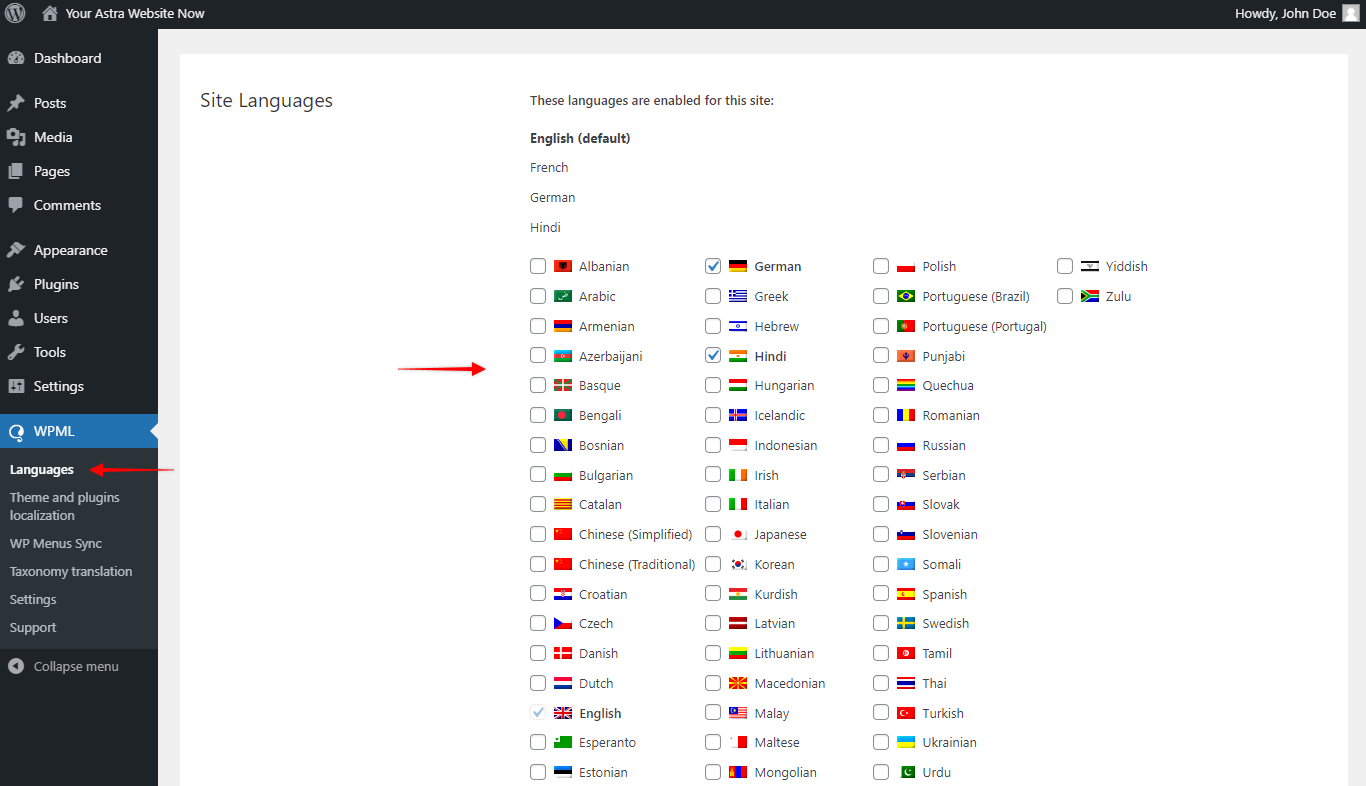
All selected languages from the step above will be available in your Header Builder with the Language Switcher.
You can customize the look of the language navigation with the following options:
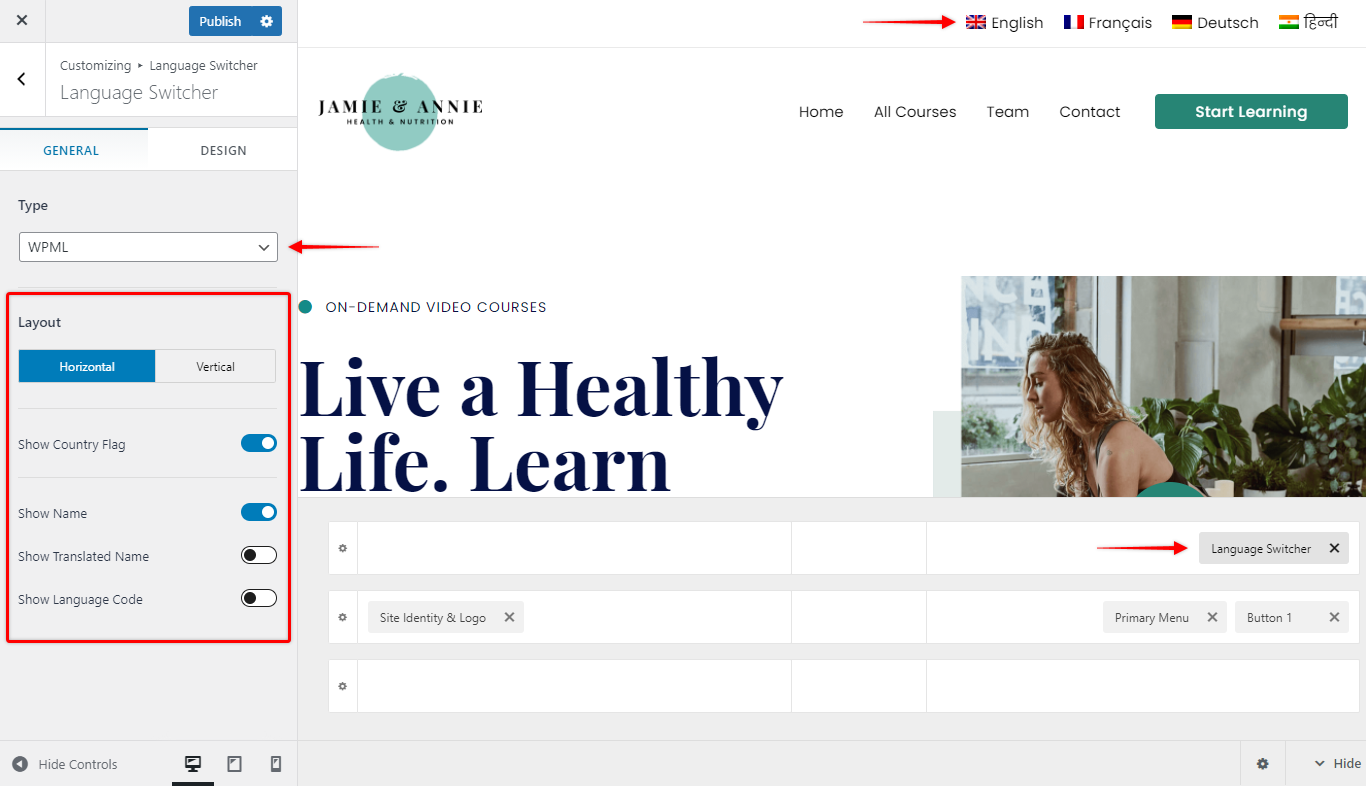
- Layout: You can either display all languages in a horizontal or vertical manner. Horizontal layout mostly applies well to the header while the vertical layout is often better suited for the footer.
- Show Country Flag: This will display flags for countries associated with the chosen language. It helps users to quickly spot the preferred language they are looking for.
- Show Name: This will display the full name for the language.
- Show Translated Name: This will display the translated names for all languages when a specific language is selected. For example – you added 4 languages, let us say English, French, German, and Hindi. When you select the German language, all languages will show their translated names in German.
- Show Language Code: This will display the language code for each language. For example – English (en), French (fr), German (de), and Hindi (hi).
Under the Design tab, you can manage spacing, typography, and the size of the items.
Language Switcher with Other Translation Plugins
If you are using any plugin other than WPML, please follow the below steps to add language navigation:
Note:
The name of the header “Logo” element was modified and the name you would see in your Header Builder is now “Site Title & Logo”
Step 1 – Navigate to Customizer > Header Header > Language Switcher. Here, select the language from the dropdown and click on the “Add Language” button. You can repeat this step for all languages you wish to add.
Step 2 – Next, click on the language bar for a specific language. This will expand the language settings, allowing you to change its label (if needed) and set the appropriate URL. This URL is actually a translated version of your website (like https://www.yoursite.com/en/) and you can find it in your translation plugin. Just paste the URL there for the respective language.
Step 3 – You can manage other things from the above settings like the horizontal/vertical layout, show country flag, and display language name.
Step 4 – Under the Design tab, you can manage the spacing, color, and typography for the items.
We don't respond to the article feedback, we use it to improve our support content.